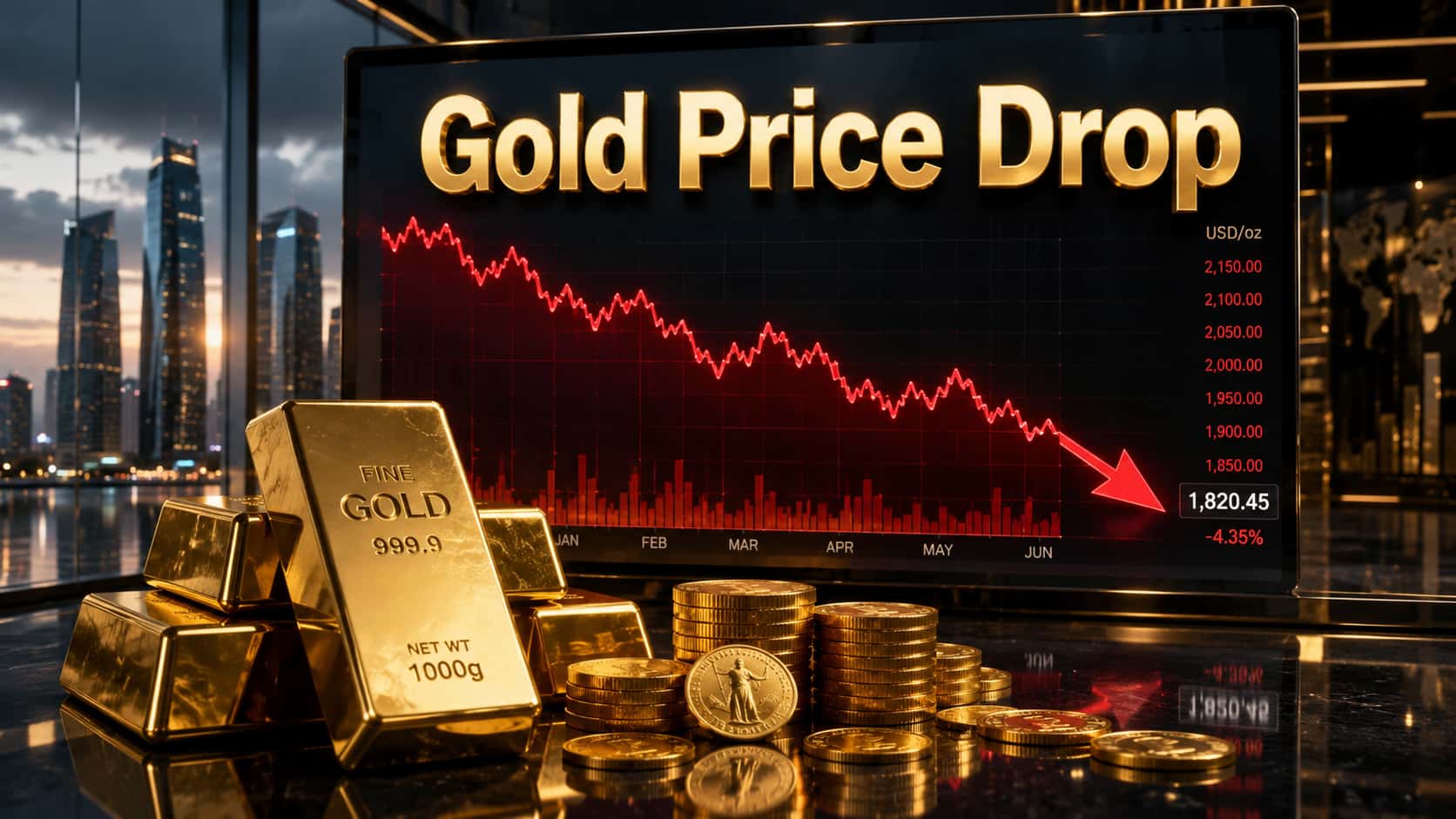
Gold prices do not move in one direction forever. Even during strong bullish cycles, the market can slow down, correct, or fall sharply when global conditions change. A gold price drop often raises important questions for investors and buyers: why did gold fall, will it drop again, and is this a good time to buy?
The answer depends on several connected factors, including U.S. interest rate expectations, the strength of the U.S. dollar, inflation data, oil prices, investor sentiment, and physical demand. For buyers in the UAE, a drop in global gold prices can also affect local gold rates, especially 24K and 22K gold prices in Dubai, Abu Dhabi, and Sharjah.
This article explains what a gold price drop really means, why gold prices fall, what could happen next, and how buyers in the UAE can think about gold bars and jewelry during a market correction.
What Does a Gold Price Drop Mean?
A gold price drop means that the market price of gold has moved lower over a specific period. This may happen within a single trading day, over a week, across a full month, or after a longer rally where gold reached a high level and then corrected.
Gold is priced globally in U.S. dollars per ounce. When the international gold price falls, local gold prices in the UAE usually move lower as well. This affects the price of different gold purities, including 24K, 22K, 21K, and 18K.
However, the local price movement is not always identical to the global movement. In the UAE, final gold prices may also be influenced by local market demand, currency stability, dealer pricing, jewelry-making charges, and the type of gold product being purchased.
For example, gold bars usually reflect the raw gold price more directly than jewelry. Jewelry prices often include design, craftsmanship, brand value, and other costs, which means they may not fall at the same rate as the global gold price.
A gold price drop does not always mean that gold is losing its long-term value. In many cases, it is simply a market correction after a strong rise, or a short-term reaction to economic news. For investors, the most important question is not only whether gold has dropped, but why it dropped and whether the reason is temporary or part of a larger trend.
Why Did Gold Price Drop?
Many buyers and investors ask the same question whenever the market turns lower: why did gold price drop after a strong period of gains?
In most cases, gold does not fall because of one single reason. A gold price drop usually happens when several market pressures come together at the same time. These may include higher U.S. interest rate expectations, a stronger U.S. dollar, profit-taking by investors, inflation concerns, oil price movements, ETF outflows, and weaker jewelry demand when prices become too high.
Gold is often seen as a safe-haven asset, but it is still affected by global financial conditions. When investors expect higher returns from bonds or cash, gold may become less attractive in the short term because it does not generate interest. At the same time, when the U.S. dollar strengthens, gold becomes more expensive for buyers using other currencies, which can reduce demand and push prices lower.
A gold price drop can also happen after a major rally. When prices rise quickly, some traders sell to secure profits. This selling pressure can turn a normal correction into a sharper decline, especially if market sentiment changes suddenly.
Higher U.S. Interest Rate Expectations
One of the biggest reasons behind a gold price drop is the expectation that U.S. interest rates may stay high for longer.
Gold does not pay interest. So when bond yields rise or investors expect higher returns from interest-bearing assets, some money can move away from gold and into bonds, cash, or other financial instruments. This increases the opportunity cost of holding gold.
For example, if investors believe the U.S. Federal Reserve will delay rate cuts because inflation is still high, gold may come under pressure. Higher interest rate expectations often support the U.S. dollar and Treasury yields, both of which can weigh on gold prices.
This does not mean gold becomes unattractive as a long-term asset. It simply means that, in the short term, higher rates can reduce demand from investors who are looking for yield.
Stronger U.S. Dollar
Another major reason behind a gold price drop is a stronger U.S. dollar.
Gold is traded globally in U.S. dollars. When the dollar rises, gold becomes more expensive for buyers who use other currencies. This can reduce demand in international markets and put pressure on gold prices.
A stronger dollar can also change investor behavior. When the dollar looks more attractive, some investors may move money into dollar-based assets instead of gold. This is especially common when the market expects higher U.S. interest rates or stronger economic data from the United States.
For buyers in the UAE, the impact is slightly different because the UAE dirham is pegged to the U.S. dollar. However, local gold prices still follow the global gold market closely. If the international price of gold falls because of dollar strength, gold rates in Dubai and across the UAE usually reflect that movement.
This is why investors often watch both the gold price and the U.S. dollar before making a buying decision. A gold price drop caused by dollar strength may be temporary if the dollar later weakens or if safe-haven demand returns to the market.
Profit-Taking After a Strong Rally
Gold can also drop after a period of strong gains because investors start taking profits.
When gold rises quickly, short-term traders may decide to sell part of their holdings to lock in gains. This selling can create downward pressure, especially if many investors act at the same time.
Profit-taking does not always mean the long-term trend has changed. Sometimes, it is simply a normal correction after gold has moved too high too fast. In fact, many long-term investors see these corrections as a natural part of the market cycle.
For UAE buyers, this type of gold price drop can be important because it may create better entry points for those planning to buy physical gold, especially gold bars. However, it is still better to compare the current price with recent weekly and monthly levels instead of reacting to a single daily movement.
Inflation and Oil Price Concerns
Inflation can affect gold in two different ways. In the long term, many investors buy gold as a hedge against inflation because gold is often seen as a store of value. But in the short term, inflation can also create pressure on gold if it makes central banks more likely to keep interest rates high.
This is why inflation sometimes supports gold and sometimes pushes it lower. If inflation rises and investors expect the U.S. Federal Reserve to respond with higher rates or delayed rate cuts, gold may fall because higher rates increase the opportunity cost of holding it.
Oil prices can add more pressure to this situation. When oil prices rise sharply, inflation concerns usually increase because energy costs affect transportation, production, and consumer prices. If markets believe higher oil prices will keep inflation elevated, gold may face short-term selling pressure.
In this case, a gold price drop does not mean inflation is no longer important. It means investors are focusing more on the interest rate response to inflation rather than inflation itself.
Market sentiment can shift quickly during global uncertainty, which is why understanding why gold prices move during tensions helps explain why gold may rise sharply in some periods and correct in others.
ETF Outflows and Investor Positioning
Gold prices are also affected by how large investors position themselves in the market.
Gold exchange-traded funds, known as gold ETFs, allow investors to gain exposure to gold without holding physical bars or coins. When these funds see strong inflows, it can support gold prices. But when investors pull money out of gold ETFs, it can add selling pressure to the market.
A gold price drop may become sharper when ETF outflows happen at the same time as weaker sentiment in futures markets. If large traders reduce their long positions or start betting on lower prices, the decline can accelerate.
This type of movement is often more visible in the short term. It reflects investor behavior more than physical gold demand. For buyers of physical gold in the UAE, this is important because a price drop caused by financial positioning may create temporary opportunities if the long-term demand for gold remains strong.
Weaker Jewelry Demand at High Prices
Physical demand also plays a role in how gold prices move, especially when prices reach high levels.
When gold becomes expensive, some jewelry buyers may delay their purchases or reduce the size of their orders. This can weaken short-term demand, especially in markets where gold jewelry is commonly bought for weddings, gifts, or personal use.
Jewelry demand is different from investment demand. A person buying jewelry may care about design, craftsmanship, and occasion. But an investor buying gold bars usually focuses more on purity, weight, price, and resale value.
This is why high gold prices can reduce jewelry demand while investment demand may remain active. Some investors may even wait for a gold price drop before buying gold bars, because bars are more closely linked to the raw gold price and usually carry lower additional costs than jewelry.
For UAE buyers, this difference matters. A drop in the global gold price may make gold bars more attractive, but jewelry prices may not fall by the same percentage because they include making charges, design costs, and retail margins.
A short-term drop does not always mean the wider trend has changed. To understand why gold prices may change in 2026, investors should compare the current correction with inflation expectations, interest rate signals, and global demand for safe-haven assets.
What Happened in the Recent Gold Decline?
The recent gold decline came after a strong rally, when prices had already moved higher over a short period. After a fast rise, the market often becomes more sensitive to changes in economic expectations, especially if investors start questioning whether gold can continue climbing at the same pace.
As pressure increased, gold began to correct. Higher U.S. interest rate expectations, a stronger dollar, and profit-taking after the rally all contributed to weaker momentum. Instead of seeing the decline as a single sudden event, it is better to view it as a market adjustment after a period of strong buying.
For buyers in the UAE, the key point is to understand the reason behind the gold price drop before making a decision. If the decline is mainly driven by short-term profit-taking, it may create a buying opportunity. But if it reflects a deeper shift in interest rates, the dollar, or investor sentiment, buyers may need to track the market more carefully before buying.
Will Gold Drop Further?
Whether gold will drop further depends on what happens next in the global economy. Gold can continue falling if the same pressures remain in place, but it can also recover quickly if market expectations change.
This is why it is better to think in scenarios rather than make one fixed prediction. Gold is affected by interest rates, the U.S. dollar, inflation data, oil prices, geopolitical risk, and investor demand. Any change in these factors can shift the direction of the market.
Bearish Scenario: Gold May Drop Further
Gold may drop further if U.S. interest rates stay high for longer than expected. When investors believe rate cuts are unlikely, bond yields may remain attractive, and this can reduce demand for gold.
A stronger U.S. dollar could also add pressure. If the dollar continues to rise, gold may become more expensive for international buyers, which can weaken demand and push prices lower.
Gold may also face more downside if ETF outflows continue or if traders keep reducing their positions after a strong rally. In this case, the market could remain under pressure until buyers return at lower levels.
Base Scenario: Gold May Move Sideways
The base scenario is that gold moves sideways for a period of time. This often happens after a sharp rally followed by a correction.
In this situation, buyers and investors may wait for clearer signals from inflation reports, central bank decisions, and the U.S. dollar. Gold may rise on some days and fall on others, but without a clear direction.
For UAE buyers, this type of market can be useful for comparison. Instead of rushing to buy after one daily drop, buyers can monitor the price over several days and compare 24K and 22K rates before making a decision.
Bullish Scenario: Gold May Recover
Gold may recover if interest rate expectations become more supportive. For example, if inflation cools and markets expect future rate cuts, gold could attract more investors again.
A weaker U.S. dollar could also support gold prices. Since gold is priced in dollars, a softer dollar can make gold more attractive to global buyers.
Geopolitical uncertainty may also bring safe-haven demand back into the market. If investors become more cautious about stocks, currencies, or global risks, gold may regain strength even after a recent drop.
In short, gold could drop further, move sideways, or recover depending on the next market signals. For buyers, the best approach is to understand the reason behind the movement instead of reacting emotionally to every price change.
What Could Trigger Another Gold Price Drop?
Many investors ask when does gold price drop and when will gold price drop again. In most cases, another decline happens when market conditions become less supportive for gold, especially when the U.S. dollar strengthens, bond yields rise, or investors expect interest rates to stay high for longer.
Gold may also come under pressure when strong economic data reduces expectations for rate cuts. If inflation remains high or the U.S. economy performs better than expected, markets may believe the Federal Reserve has less reason to ease monetary policy. This can support the dollar and Treasury yields, both of which can weigh on gold.
Another trigger is weaker safe-haven demand. Gold often benefits from uncertainty, so if geopolitical tensions ease or investors become more confident in riskier assets such as stocks, some demand for gold may decline. ETF outflows and reduced investor positioning can also add short-term selling pressure.
For UAE buyers, the goal should not be to predict the exact bottom. A better approach is to monitor the main signals behind any gold price drop, including U.S. inflation reports, Federal Reserve decisions, dollar movement, bond yields, oil prices, geopolitical developments, and local 24K and 22K gold rates.
Before buying, compare current gold prices with recent weekly and monthly levels, understand what is driving the decline, and decide whether the price fits your investment or buying goal.
Gold Price Drop in UAE: What It Means for Buyers
A gold price drop in the global market usually affects gold prices in the UAE because local gold rates are closely linked to the international spot price. When the global price of gold moves lower, buyers in Dubai, Abu Dhabi, Sharjah, and other emirates often see changes in 24K, 22K, 21K, and 18K gold rates.
However, the local market does not always move at the exact same speed or percentage as the global market. UAE gold prices can also be influenced by local demand, dealer pricing, product type, and additional costs such as making charges on jewelry.
This is especially important when comparing gold bars and jewelry. Gold bars usually follow the raw gold price more directly because they are mainly valued by purity and weight. Jewelry, on the other hand, includes craftsmanship, design, brand value, and retail margins. As a result, a drop in gold prices may be more visible when buying bars than when buying jewelry.
For buyers in the UAE, a gold price drop can create a useful moment to review the market. Some buyers may see it as a chance to enter at a better price, while others may prefer to wait and see if the decline continues. The right decision depends on the purpose of buying.
If the goal is investment, buyers may focus more on 24K gold bars, premiums, and long-term value. If the goal is personal use or gifting, jewelry design and making charges may matter more than the daily gold rate alone.
The most important point is to avoid making a decision based only on one day of movement. A price drop may be temporary, or it may be part of a larger correction. UAE buyers should compare current gold rates with recent weekly and monthly levels before deciding whether to buy now or wait.

Is a Gold Price Drop a Good Time to Buy Gold Bars?
A gold price drop can be a good time to buy gold bars, especially for buyers who are focused on long-term value rather than short-term price movements. When gold prices move lower, investors may get a chance to buy physical gold at a more attractive level compared to recent highs.
Gold bars are often preferred by investors because they are closely linked to the raw gold price. Unlike jewelry, gold bars usually carry fewer additional costs related to design and craftsmanship. This makes them easier to compare, easier to price, and more suitable for buyers who want direct exposure to the value of gold itself.
For UAE buyers, this is especially important because gold bars are available in different weights, from smaller bars for personal investment to larger bars for traders and serious investors. During a gold price drop, buyers can compare the current gold rate with the bar weight, premium, and purity before making a decision.
However, a lower price does not always mean it is the perfect time to buy. The reason behind the drop matters. If gold is falling because of short-term profit-taking, the decline may create a useful buying opportunity. But if gold is under pressure because of a stronger dollar and higher interest rate expectations, buyers may want to monitor the market more carefully.
A smart approach is to avoid trying to catch the exact bottom. Instead, buyers can compare prices over several days, follow weekly and monthly trends, and decide whether the current level fits their investment goal.
For UAE buyers, choosing a trusted gold supplier is just as important as choosing the right buying time. Delor provides gold bars and selected gold products for investors, traders, and customers looking for physical gold in the UAE. During a gold price drop, clear pricing, purity, weight options, and supplier trust can help buyers make a more confident decision.
In the end, a gold price drop should be seen as a decision point, not a signal to rush. The best time to buy gold bars depends on your budget, investment goal, and confidence in the long-term role of gold as a store of value.

Gold Bars vs Jewelry During a Gold Price Drop
Gold bars and jewelry do not react to a gold price drop in the same way. Both contain real gold, but they are priced differently and usually serve different buying goals.
Gold bars are mainly valued by weight, purity, and the current market price of gold. This makes them more directly connected to the international gold price. When gold prices fall, the impact is often clearer for buyers comparing gold bar prices because the product is closer to the raw metal value.
Jewelry is different. The final price of a gold jewelry piece includes more than the gold content. Buyers also pay for design, craftsmanship, brand value, retail margins, and making charges. Because of these extra costs, jewelry prices may not fall by the same percentage as the global gold price.
This difference is important for UAE buyers. If the goal is investment or long-term saving, gold bars may be more suitable because they are easier to compare and usually have lower additional costs. If the goal is gifting, personal use, or style, jewelry may still be the better option, even if it carries higher extra charges.
During a gold price drop, investors often focus on gold bars because they want to benefit from the lower gold rate as directly as possible. Jewelry buyers, on the other hand, should look beyond the daily gold rate and consider the total cost of the item, including making charges and resale value.
In simple terms, gold bars are usually better for investment, while jewelry is better for personal use and occasion-based purchases. The right choice depends on why you are buying gold in the first place.

How to Track Gold Price Drops Before Buying
Before buying during a gold price drop, it is important to look beyond the daily price movement. Gold can fall for one day and recover the next, or it can continue moving lower if the same market pressures remain in place.
The first thing to watch is the international gold price per ounce. This is the main benchmark that influences gold rates around the world, including the UAE. If the global price continues to fall, local 24K and 22K prices may also move lower.
Buyers should also compare today’s price with recent weekly and monthly levels. A small daily drop may look attractive, but it may not be significant if gold is still trading near recent highs. Looking at a wider period gives a clearer picture of whether the market is truly correcting or only moving slightly.
The U.S. dollar is another important signal. Since gold is priced in dollars, a stronger dollar can pressure gold, while a weaker dollar can support it. Interest rate expectations also matter because higher rates can make gold less attractive compared to yield-generating assets.
For UAE buyers, it is also useful to follow local gold rates for 24K, 22K, 21K, and 18K. This helps you understand how the global movement is being reflected in the local market. If you are buying gold bars, compare the gold rate with the final bar price, including any premium.
A good buying decision should be based on a combination of factors: the current gold price, recent trends, the reason behind the drop, your budget, and your investment goal. Instead of trying to predict the perfect bottom, it is often better to buy with a clear plan and from a trusted source.

Final Thoughts on Gold Price Drop
A gold price drop is a normal part of the gold market cycle. Gold can rise strongly during periods of uncertainty, inflation fears, or strong investor demand, but it can also correct when the U.S. dollar strengthens, interest rate expectations change, or investors take profits after a rally.
For buyers and investors, the most important point is not only that gold has dropped, but why it dropped. A short-term correction may create a useful buying opportunity, especially for those interested in gold bars. But a deeper decline caused by stronger economic pressure may require more patience and closer market tracking.
In the UAE, gold buyers should compare global gold movements with local 24K and 22K rates before making a decision. They should also understand the difference between gold bars and jewelry, because each product reacts differently to price changes.
If your goal is long-term investment, a gold price drop can be a moment to review the market, compare prices, and consider buying gradually. If your goal is jewelry or personal use, it is still important to check the full cost, including making charges and resale value.
Gold may continue to move up and down, but its role as a store of value remains important for many buyers. The best decision comes from understanding the market, choosing the right product, and buying from a trusted source.
FAQs About Gold Price Drop
Why did gold price drop?
Gold price usually drops because of a combination of factors, not one single reason. The most common reasons include higher U.S. interest rate expectations, a stronger U.S. dollar, profit-taking after a strong rally, ETF outflows, and weaker demand when prices become too high.
Will gold price drop again?
Gold may drop again if the U.S. dollar strengthens, bond yields rise, interest rate cuts are delayed, or investors reduce demand for safe-haven assets. However, gold may recover if inflation cools, rate cut expectations return, or geopolitical uncertainty increases.
When does gold price drop?
Gold price often drops when the market expects higher interest rates, the U.S. dollar becomes stronger, or investors move money into assets that offer returns such as bonds or stocks. It can also drop after a strong rally when traders start taking profits.
When will gold price drop?
No one can predict the exact timing of the next gold price drop. Buyers usually watch U.S. inflation reports, Federal Reserve decisions, Treasury yields, dollar movement, and global risk sentiment to understand when gold may come under pressure again.
Is a gold price drop a good time to buy gold bars?
A gold price drop can be a good time to buy gold bars if your goal is long-term investment. Gold bars are usually closer to the raw gold price than jewelry, which makes them easier to compare during market corrections. Still, buyers should check the reason behind the drop and avoid rushing based on one-day price movement.
What is the difference between gold bars and jewelry during a price drop?
Gold bars usually reflect the gold market price more directly because they are priced mainly by weight and purity. Jewelry includes extra costs such as design, craftsmanship, brand value, and making charges, so it may not fall by the same percentage as the global gold price.