Gold has once again taken center stage in global markets. In late February 2026, prices surged above the $5,300 per ounce level for the first time in history, driven by escalating geopolitical tensions, renewed U.S.–Iran friction, and rising trade policy uncertainty. At the same time, silver outperformed with gains approaching 9% during peak volatility, highlighting how precious metals respond rapidly to political instability.
These sharp moves are not random. Historically, periods of war, sanctions, and diplomatic conflict have triggered capital flows into so-called “safe-haven” assets. Investors seek protection from currency weakness, equity market drawdowns, and falling real yields — and gold often becomes the primary beneficiary.
But does gold always rise during political crises? And why does silver sometimes move even more aggressively?
This data-driven analysis examines the economic mechanisms behind these price movements, reviews the latest 2026 market evidence, and explains what geopolitical risk means for both short-term traders and long-term investors in today’s global environment.
Why Gold Rises During Political Tensions
Gold’s reaction to geopolitical instability follows a clear economic logic. When uncertainty rises, capital reallocates. Investors shift away from risk-sensitive assets and toward instruments perceived as stable, liquid, and independent from government default risk.
The “Flight to Safety” Effect
During wars, sanctions, or diplomatic escalations, equity markets often experience volatility. Institutional capital typically rotates into defensive assets — US Treasuries, the US dollar, and gold.
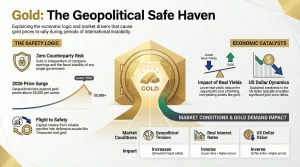
Gold stands out because it carries no counterparty risk. It is not tied to the earnings of a company or the fiscal stability of a single government. In early 2026, as geopolitical risks intensified, this dynamic helped push gold above $5,200 per ounce, according to market coverage from Reuters and FXStreet.
Real Yields and the US Dollar
Gold’s price is strongly influenced by real interest rates (nominal yields minus inflation). When geopolitical stress increases, investors often anticipate economic slowdown or monetary easing, which can suppress real yields. Lower real yields reduce the opportunity cost of holding non-yielding assets like gold.
Additionally, while gold and the US dollar sometimes move together during extreme crises, sustained dollar weakness tends to amplify gold rallies. In several phases of 2026 volatility, softer dollar conditions provided additional support to the metal.
Central Bank Accumulation
Another structural driver behind gold’s resilience is central bank demand. Over the past three years, global central banks have purchased more than 1,000 tonnes annually, according to reports from major financial institutions including J.P. Morgan.
These purchases are often motivated by reserve diversification and reduced reliance on dollar-denominated assets amid sanctions risk. This steady institutional demand creates a structural floor under gold prices, even during temporary corrections.
How Geopolitical Conflicts Create Gold Price Volatility
Geopolitical conflicts have repeatedly resulted in significant gold price volatility. When tensions escalate between major economies or military conflicts emerge, financial markets often react quickly.
Investors typically move capital away from equities and risk-sensitive assets toward traditional safe havens such as gold and government bonds. This rapid capital rotation explains why gold prices often spike during geopolitical crises before stabilizing once markets adjust to new political realities.
The volatility observed in early 2026 — including gold briefly surpassing the $5,300 level — reflects this historical pattern.
Why Silver Moves More Than Gold in Crises
Silver often reacts more aggressively than gold during geopolitical shocks — both upward and downward. The reason lies in its dual role within the global economy.
Dual Nature: Industrial and Investment Demand
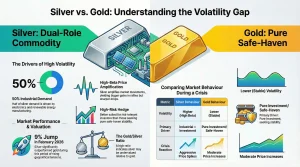
Unlike gold, which is primarily a monetary and investment asset, roughly half of silver demand comes from industrial applications. It is essential in electronics, renewable energy systems, and advanced manufacturing.
When geopolitical risk increases, investment demand for silver rises alongside gold. In February 2026, silver surged nearly 9% during peak tension, outperforming gold’s gains over the same period, according to Forbes.
Higher Volatility and Beta
Silver historically exhibits higher volatility than gold. In market terms, it has a higher “beta,” meaning it tends to amplify broader precious metal movements.
During crisis-driven rallies, this can translate into stronger percentage gains. However, when tensions ease, silver frequently corrects more sharply than gold. This makes it attractive for higher-risk investors but less stable as a pure hedge.
For investors considering investing in silver, this higher volatility means silver may offer stronger upside during crises, but it also requires more careful risk management than gold.
The Gold/Silver Ratio
Investors often monitor the Gold/Silver ratio to assess relative value. A high ratio suggests silver may be undervalued compared to gold, while a low ratio may indicate silver is relatively expensive.
During early 2026 volatility, fluctuations in this ratio reflected shifting investor preference between stability (gold) and higher upside potential (silver).
2026 Case Study: What the Market Data Shows
The events of early 2026 provide a clear example of how geopolitical risk impacts precious metals:
- Gold broke above $5,200 per ounce for the first time.
- Weekly gains approached 5% during peak escalation.
- Silver advanced close to 9%, outperforming gold.
- Temporary pullbacks followed periods of de-escalation.
Event | Gold Move | Silver Move | Duration |
U.S.-Iran Escalation | +7% (wk) | ~9% | Short forbes |
| Trade Fears | +5% | +8% | Medium |
For a detailed breakdown of how gold performed specifically in the UAE market during this period, see our full report: Gold Price in UAE February 2026: Market Analysis and Outlook, which covers local pricing dynamics, premiums, and demand trends.
The pattern remains consistent with historical precedent:
Rapid surge during uncertainty → Stabilization or correction after political clarity emerges.
This reinforces the importance of distinguishing between structural trends and short-term panic-driven price spikes.
Gold Price Forecast 2026: How Geopolitical Tensions Could Shape the Market
Market analysts increasingly link the gold price forecast for 2026 to geopolitical tensions and global economic uncertainty. Periods of conflict, sanctions, and trade disputes often drive investors toward safe-haven assets, reinforcing gold’s long-term demand.
Several institutions believe that geopolitical risks could remain one of the most important drivers for gold prices throughout 2026. If tensions continue in key regions or trade disputes intensify, gold may remain structurally supported even during temporary market corrections.
For a broader view of the 2026 gold market outlook, investors should compare geopolitical risks with inflation expectations, real yields, central bank demand, and US dollar movements.
Institutional Gold Price Forecasts
One example comes from J.P. Morgan Commodities Research, which projects that gold prices could remain elevated throughout 2026 and potentially move higher into 2027.
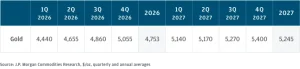
Source: J.P. Morgan Commodities Research – Gold Price Forecasts 2026–2027
Their projections indicate quarterly averages near $4,440 in early 2026, potentially rising toward $5,055 by the fourth quarter if macroeconomic conditions remain supportive. Looking further ahead, forecasts suggest gold could approach $5,400 per ounce in 2027 under favorable geopolitical and monetary conditions.
Will Gold Continue Rising in 2026?
After breaking above the $5,200 level, investors are now debating whether gold is in the middle of a long-term bull cycle or approaching a temporary peak. The outlook depends largely on macroeconomic conditions and geopolitical developments.
Bullish Scenario
Several major financial institutions have outlined constructive projections for gold in 2026:
- Deutsche Bank has suggested that gold could approach $6,000 per ounce if geopolitical instability persists.
- Bank of America projected levels around $5,000+ during 2026 under supportive macro conditions.
- Additional market analyses point to even higher upside targets in prolonged escalation scenarios.
The key drivers behind a continued rally would include:
- Ongoing geopolitical tension or conflict expansion
- Sustained central bank gold purchases
- Weakness in the US dollar
- Declining real yields
- Increased ETF inflows
Under this framework, gold would remain structurally supported even if short-term volatility increases.
Bearish Scenario
On the other hand, several factors could limit or reverse gold’s momentum:
- Diplomatic resolution of major geopolitical conflicts
- Stronger US dollar recovery
- Rising real interest rates
- Reduced risk aversion in equity markets
If political tensions ease quickly and global growth stabilizes, gold could experience a corrective phase before any further structural advance.
What This Means for Long-Term Investors
For long-term investors, geopolitical volatility should not be viewed purely as a short-term trading opportunity. Instead, it reinforces gold’s role as a strategic portfolio hedge.
Historically, gold has demonstrated resilience across economic cycles, especially during inflationary periods and geopolitical shocks. While short-term price spikes often retrace partially, the broader trend during prolonged instability tends to favor sustained allocation.
Many portfolio strategies suggest maintaining a 5–15% allocation to gold, depending on risk tolerance and investment objectives. Approaches such as dollar-cost averaging (DCA) can reduce timing risk during volatile phases.
Investors assessing whether current geopolitical volatility creates a strategic entry opportunity can explore our in-depth analysis in Is It a Good Time to Buy Gold in the UAE? 2026 Market Analysis, where we examine market timing considerations in detail.
Silver, meanwhile, may offer higher upside potential but with greater price swings. Investors seeking stability may prioritize gold, while those with higher risk tolerance may consider selective silver exposure.
Ultimately, successful positioning during political uncertainty requires:
- Risk management discipline
- Diversification across asset classes
- Avoiding emotionally driven decisions
- Maintaining a long-term strategic framework
Gold Price Outlook 2026: Key Geopolitical Risks to Watch
Looking ahead, several geopolitical developments could influence gold and silver prices throughout 2026.
Key risks include:
Escalation of regional conflicts in the Middle East
Trade tensions between major global economies
Sanctions affecting global energy and commodity markets
Political uncertainty during major elections
If these geopolitical risks intensify, gold may continue to benefit from safe-haven demand, while silver could experience amplified price movements due to its higher market volatility.
Frequently Asked Questions
Does gold always rise during wars?
Gold often rises during geopolitical conflicts due to safe-haven demand. However, gains are not guaranteed and may reverse once tensions de-escalate or monetary conditions tighten.
Is silver better than gold during geopolitical crises?
Silver can outperform gold during periods of intense volatility, but it also tends to correct more sharply. Gold remains the more stable hedge, while silver offers higher potential upside with increased risk.
How high could gold go in 2026?
Forecasts vary widely. Some institutions have projected levels between $5,000 and $6,000 depending on geopolitical and macroeconomic conditions. Outcomes depend largely on real yields, central bank demand, and global risk dynamics.
What happens to gold after conflicts end?
Gold often stabilizes or retraces part of its crisis-driven gains once political uncertainty declines. However, if underlying macroeconomic pressures persist, long-term upward trends may continue.
Is gold still a safe haven in 2026?
Yes, gold continues to function as a safe-haven asset, particularly during periods of geopolitical instability, inflation risk, and currency uncertainty.
Sources & Data
This analysis is based on publicly available market data and institutional research published in February–March 2026, including the following reports and coverage:
- Reuters – Gold rally past $5,200 (2026)
- FXStreet – Gold holds above $5,200 amid geopolitical risks
- Forbes – Silver surges nearly 9% amid Iran tensions (Feb 2026)
- AInvest – Gold price surges past $5,200
- J.P. Morgan Global Research – Gold Outlook 2026
- UBP – Investment Outlook 2026 (Gold demand trends)
- Deutsche Bank projection (via Reuters coverage)
- Bank of America Gold Price Target 2026
All percentage movements, price levels, and institutional projections referenced in this article are derived from the reports above and reflect market conditions during the first quarter of 2026.